Inverse Fair Value Gap for NinjaTrader 8
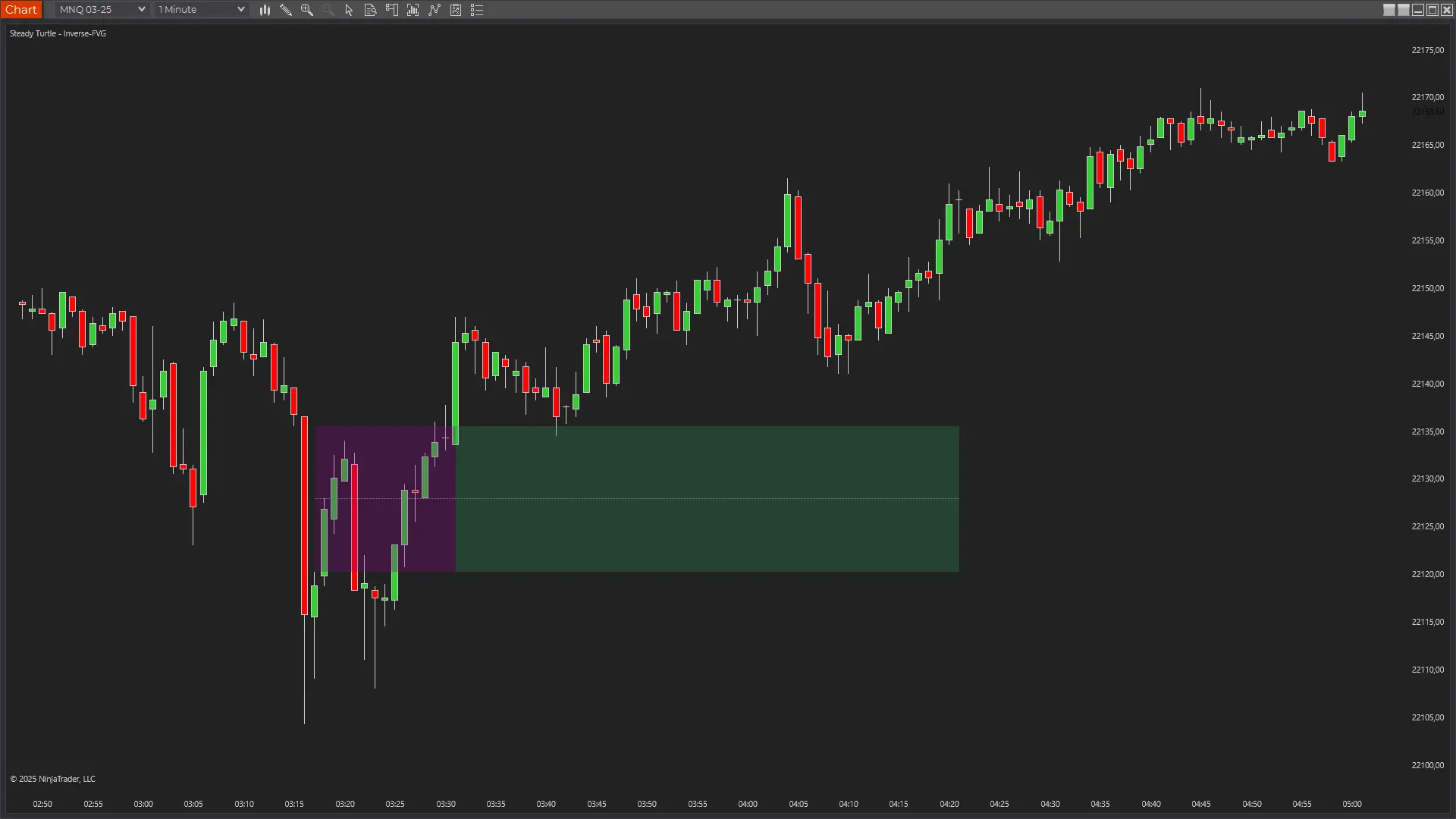
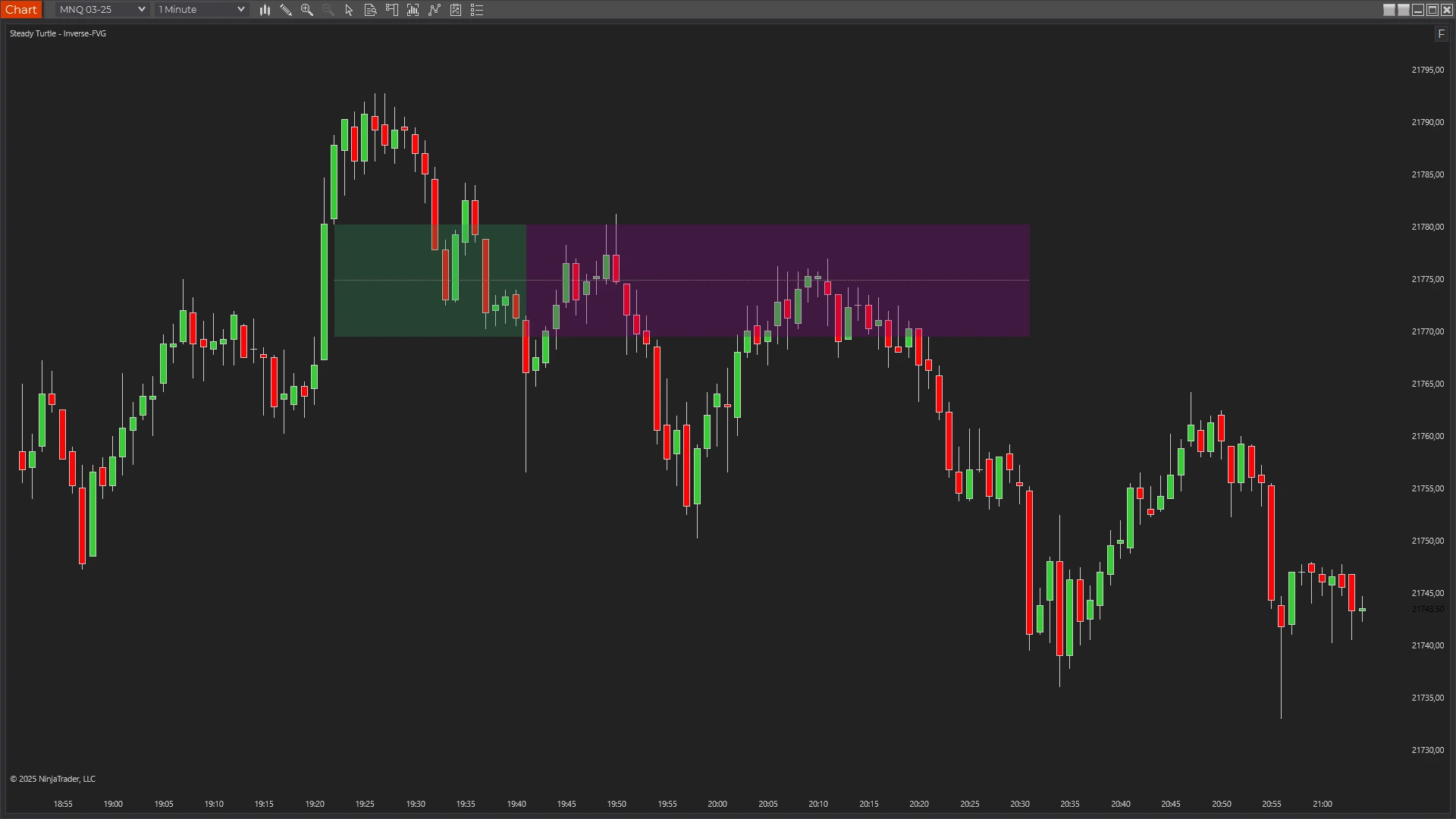
Automatically detects Fair Value Gaps and tracks when they invert. When price closes through an FVG in the opposite direction, what was support becomes resistance (or vice versa). The indicator changes color to show the flip—giving you a clear signal that the market's behavior at that level has changed.
See It in Action
Watch how the Inverse FVG indicator identifies and tracks fair value gaps on your NinjaTrader charts.
Fair Value Gap Detection with Inversion Tracking
Fair Value Gaps form when price moves so quickly that it leaves a gap between candle wicks. These imbalances often act as support or resistance when price returns. This indicator finds them automatically and—more importantly—tells you when they've failed.
Bullish FVG Detection
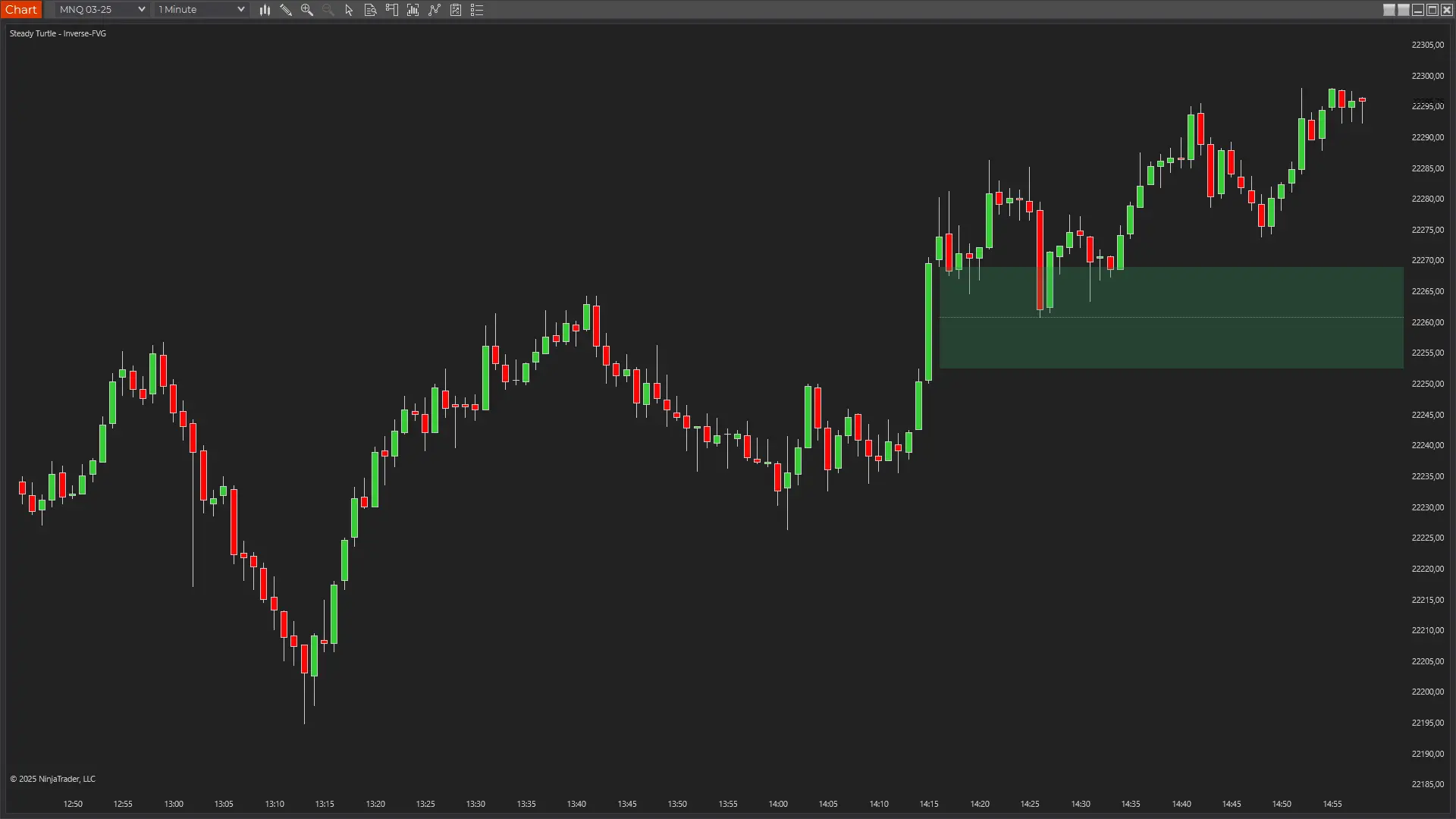
A bullish FVG forms when the low of a candle is higher than the high of two candles ago, leaving a gap. This indicates aggressive buying and the gap often acts as support on retests. The indicator marks these with a colored box and optional midline.
Bearish FVG Detection
A bearish FVG forms when the high of a candle is lower than the low of two candles ago. This indicates aggressive selling and the gap often acts as resistance on retests. Bearish FVGs are marked in a different color for easy identification.
Inversion Detection
The key feature: when price closes through an FVG in the opposite direction, the indicator changes color. A bullish FVG that gets broken becomes a "bearish inversed" zone. This flip signals that the level's role has changed—failed support now acts as resistance.
High-Probability Filter
Optionally filter to show only FVGs where the middle candle is the largest of the three—a sign of stronger momentum behind the gap. This reduces noise and highlights the gaps most likely to hold as support or resistance.
Trading with Fair Value Gaps
FVGs are a core concept in ICT (Inner Circle Trader) and Smart Money Concepts methodologies. Here's how traders typically incorporate them into their analysis.
FVG as Support/Resistance
The most straightforward use: when price returns to a Fair Value Gap, watch for a reaction. A bullish FVG that hasn't been violated often acts as support—price bounces from within the gap or at its edge. Same concept in reverse for bearish FVGs acting as resistance.
- Enter on the first touch of an untested FVG
- Stop below the FVG low (for bullish) or above the FVG high (for bearish)
- The 50% midline often provides precise entry points
Trading the Inversion
When an FVG inverts, it signals a potential shift in market structure. A bullish FVG that gets decisively broken suggests buyers couldn't defend the level—what was support now becomes resistance. This inversion often provides high-probability short entries on retests.
- Wait for the color change confirming the inversion
- Enter on the retest of the now-inversed zone
- The inversed FVG defines your invalidation level
Confluence with Other Levels
FVGs become more significant when they align with other technical levels—prior day high/low, pivot points, or weekly structure. An FVG that coincides with yesterday's high, for example, creates a stronger zone of interest. Use the Inverse FVG indicator alongside other Steady Turtle indicators for confluence.
- Layer FVGs with Intraday Levels for stronger zones
- Watch for FVGs near Initial Balance extensions
- Multiple confluent factors increase probability
On Real Futures Charts
See how the Inverse FVG indicator marks Fair Value Gaps and their inversions across different market conditions on ES and NQ futures.
Indicator Settings
Customize the indicator to match your trading preferences.
| Setting | Default | Description |
|---|---|---|
| Min FVG Size (Ticks) | 20 | Minimum gap size in ticks to be detected |
| Max FVG Size (Ticks) | 40 | Maximum gap size in ticks |
| Remove Invalidated Gaps | True | If unchecked, invalidated gaps remain on chart but stop extending |
| Show Only High Probable Gaps | False | Only show gaps where the middle candle body is larger than surrounding candles |
| Use Candle 2 Inversion | False | If checked, inversion triggers on close beyond middle candle high/low (less restrictive) |
| Max Lookback Bars | 240 | Only show gaps created within the last X bars |
| Bull Color (Normal) | SeaGreen | Color for bullish Fair Value Gaps |
| Bull Color (Inversed) | Purple | Color for bullish FVGs after they invert |
| Bear Color (Normal) | Purple | Color for bearish Fair Value Gaps |
| Bear Color (Inversed) | SeaGreen | Color for bearish FVGs after they invert |
| Box Opacity | 20 | Transparency of FVG boxes (1-100) |
| Show Midline | True | Draw a line at the 50% level of each FVG |
| Midline Color | Gray | Color of the midline |
| Midline Opacity | 40 | Transparency of the midline (1-100) |
Minimum gap size in ticks to be detected
Maximum gap size in ticks
If unchecked, invalidated gaps remain on chart but stop extending
Only show gaps where the middle candle body is larger than surrounding candles
If checked, inversion triggers on close beyond middle candle high/low (less restrictive)
Only show gaps created within the last X bars
Color for bullish Fair Value Gaps
Color for bullish FVGs after they invert
Color for bearish Fair Value Gaps
Color for bearish FVGs after they invert
Transparency of FVG boxes (1-100)
Draw a line at the 50% level of each FVG
Color of the midline
Transparency of the midline (1-100)
What Users Say
Trusted by futures traders worldwide
The inversion detection is what got me to buy. Knowing when an FVG fails and flips from support to resistance gives me entries I'd totally miss otherwise.
Clean setup that actually matches ICT concepts right. That high-probability filter cuts out all the junk so I only see FVGs worth looking at.
I run this with the Intraday Levels indicator. When an FVG lines up with yesterday's high or a pivot, that's my best setup by far.
Finally an FVG indicator that doesn't spam my chart with every little gap. The filters work great for ES and NQ out of the box.
That midline feature is low key really useful. Price hits the 50% of an FVG more than you'd think—nice to have it auto drawn.
Been running this for 3 months on NQ. Those inversed FVGs are basically my main reversal signal now. Simple idea, works great.
NinjaTrader Indicator Pricing & Packages
Choose the option that works best for your trading needs. All purchases include free lifetime updates and personal support from a fellow trader.
Single Indicator
Focus on one powerful tool that gives you a precise edge in identifying trading setups.
$49 /one-time
- 1 Indicator
- Lifetime updates
- Email support
Traders Complete Bundle
Complete suite of professional trading tools for serious futures traders. Get all current indicators plus every new indicator released in the future.
$299 /one-time $980
- 5 Core Indicators
- Initial Balance (IB), Intraday Key Levels, Inverse Fair Value Gap (iFVG), Opening Range Breakout (ORB), Overnight Sessions
- All Advanced Indicators
- Delta Profile, Dynamic Standard Deviations, Profit Forecast, Relative Volume (RVOL), Session-Anchored-VWAP
- All future indicators
- Lifetime updates
- Priority email support
Traders Starter Bundle
$149 /one-time $245
- 5 Core indicators
- Initial Balance (IB), Intraday Key Levels, Inverse Fair Value Gap (iFVG), Opening Range Breakout (ORB), Overnight Sessions
- Lifetime updates
- Priority email support
Common Questions
- A Fair Value Gap (FVG) is a three-candle pattern where the middle candle's body is so large that it leaves a gap between the wicks of the first and third candles. For a bullish FVG: the low of candle 3 is higher than the high of candle 1. For a bearish FVG: the high of candle 3 is lower than the low of candle 1. These gaps represent areas where price moved too quickly, often acting as support/resistance when price returns.
- An inverse FVG (or inversed FVG) is a Fair Value Gap that has been broken through by price closing on the other side. When a bullish FVG gets broken to the downside, it inverts—what was support now becomes resistance. The indicator tracks this and changes the color of the box to show the inversion. This is a key signal that the market's behavior at that level has fundamentally changed.
- When "Show All FVGs" is turned off (the default), the indicator only displays FVGs where the middle candle has the largest body of the three candles. This filters out weak FVGs caused by small price movements and highlights the gaps created by strong momentum—which are statistically more likely to act as significant support or resistance.
- It depends on the instrument and your chart timeframe. The defaults (20-60 ticks) work well for NQ on 5-minute charts. For ES, you might lower the minimum to 10-15 ticks since ES has smaller typical moves. For crude oil (CL), you might use 15-40 ticks. The goal is to filter out insignificant micro-gaps while catching institutional-sized moves.
- The "Bars Active" setting controls how long an FVG stays on the chart. Old FVGs become less relevant as market context changes. The 30-bar default keeps your chart clean while showing recent, actionable zones. For longer-term analysis, increase this value. For scalping, you might decrease it to 10-15 bars.
- Yes, this indicator implements core ICT (Inner Circle Trader) concepts. Fair Value Gaps are a fundamental element of ICT methodology, used to identify institutional order flow and price inefficiencies. The inversion tracking aligns with ICT's concepts of support becoming resistance and vice versa. Many SMC (Smart Money Concepts) traders use FVGs as entry zones.
- The midline marks the 50% level of each FVG. In ICT methodology, the "consequent encroachment" or 50% level of an FVG is often where price finds the strongest reaction. Some traders use the midline as their precise entry point rather than the full gap zone. You can toggle it on/off and customize its appearance.
See the Gaps. Trade the Inversions.
Fair Value Gaps mark where institutions moved price aggressively. The Inverse FVG indicator finds them automatically and tells you when they've failed — turning support into resistance and vice versa.
One-time purchase · Lifetime updates · Instant access
Futures and forex trading contains substantial risk and is not for every investor. An investor could potentially lose all or more than the initial investment. Risk capital is money that can be lost without jeopardizing ones' financial security or life style. Only risk capital should be used for trading and only those with sufficient risk capital should consider trading. Past performance is not necessarily indicative of future results.
Testimonials appearing on this website may not be representative of other clients or customers and is not a guarantee of future performance or success.
Hypothetical performance results have many inherent limitations, some of which are described below. No representation is being made that any account will or is likely to achieve profits or losses similar to those shown; in fact, there are frequently sharp differences between hypothetical performance results and the actual results subsequently achieved by any particular trading program. One of the limitations of hypothetical performance results is that they are generally prepared with the benefit of hindsight. In addition, hypothetical trading does not involve financial risk, and no hypothetical trading record can completely account for the impact of financial risk of actual trading. For example, the ability to withstand losses or to adhere to a particular trading program in spite of trading losses are material points which can also adversely affect actual trading results. There are numerous other factors related to the markets in general or to the implementation of any specific trading program which cannot be fully accounted for in the preparation of hypothetical performance results and all which can adversely affect trading results.