Fair Value Gap for NinjaTrader 8
Start identifying institutional price imbalances with our free starter indicator. Learn how Fair Value Gaps work before upgrading to the professional Inverse FVG indicator with advanced features like inversion detection and dynamic color changes.
Free Download
Get Your Free Fair Value Gap Indicator
Enter your email to receive the download link instantly. No payment information required.
We respect your privacy. Unsubscribe anytime.
Basic Fair Value Gap Detection
Our free FVG indicator detects standard price imbalances—perfect for learning how institutional traders leave footprints in the market.
Bullish Gap Detection
Automatically identifies bullish Fair Value Gaps where the low of a candle is higher than the high of two candles ago. These gaps indicate aggressive buying and often act as support when price returns.
Bearish Gap Detection
Detects bearish Fair Value Gaps where the high of a candle is lower than the low of two candles ago. These gaps signal aggressive selling and typically act as resistance on retests.
Color-Coded Visualization
Bullish and bearish FVGs are displayed in different colors for easy identification. See at a glance whether a gap represents buying or selling pressure from institutions.
Multi-Timeframe Support
Works on any timeframe from 1-minute scalping charts to daily swing trading charts. Fair Value Gaps appear across all timeframes—the indicator adapts to your trading style.
What Is a Fair Value Gap?
The institutional price action concept every futures trader should understand
FVG Definition
A three-candle price pattern where the market moved so aggressively that it left a gap between the wicks of the first and third candles — an area of inefficient price delivery where buy and sell orders were not properly matched.
Bullish Fair Value Gap
Forms when the low of candle 3 is higher than the high of candle 1. This gap indicates aggressive institutional buying and often acts as support when price returns to test the zone.
Bearish Fair Value Gap
Forms when the high of candle 3 is lower than the low of candle 1. This signals aggressive institutional selling and typically acts as resistance on retests of the gap zone.
Why FVGs Get Filled
The market seeks efficient price delivery. Unfilled orders inside gaps draw price back to rebalance. Strong trend FVGs may only fill to the 50% midline, while weaker gaps tend to fill entirely.
The ICT & Smart Money Framework
Fair Value Gaps are a core concept in ICT (Inner Circle Trader) methodology and the broader Smart Money Concepts (SMC) framework. Institutional traders — banks, hedge funds, and algorithmic desks — create these imbalances when they aggressively execute large orders. Because the market seeks efficient price delivery, it often returns to these zones to rebalance unfilled orders, creating predictable trading opportunities. In practical terms, a fair value gap is a price magnet — a footprint left by institutional money that the market tends to revisit.
Bullish FVG in Detail
Institutional buyers who missed the initial move may have resting orders inside the gap, creating demand that pushes price back up.
Example: If ES is rallying and candle 1's high is at 5200, then candle 3's low is at 5203, the 3-point gap between 5200 and 5203 is a bullish FVG. When price pulls back to this zone, watch for a bounce.
Bearish FVG in Detail
Price dropped so fast that it left unfilled orders above. Institutional sellers defend these zones when price returns.
Example: If NQ drops sharply and leaves a bearish gap, a retracement into that gap is likely to get rejected as institutional sellers defend the level with resting orders.
Partial Fills vs Full Fills
Not every fair value gap fills completely. Strong trend FVGs — created during a powerful directional move — may only see a partial fill to the 50% midline before price continues in the original direction. This partial fill is a common entry point used by ICT traders for trend continuation trades. Range-bound or weaker FVGs tend to fill entirely as price rotates. Learning to distinguish which gaps will hold versus fill completely is the key to effective fair value gap trading.
Want to go deeper? Our complete 5-part guide covers identification, trading strategies, psychology, and advanced techniques.
Read the Complete Fair Value Gap GuideCompare Versions
Free FVG vs Professional IFVG
The free indicator teaches you the basics. The professional version gives you the edge.
| Feature | Free FVG | Pro IFVG ($49) |
|---|---|---|
| Standard FVG Detection | ✓ | ✓ |
| Bullish/Bearish Identification | ✓ | ✓ |
| Inversion Detection (Key Feature) | — | ✓ |
| Dynamic Color Changes | — | ✓ |
| Gap Size Filtering (Min/Max) | — | ✓ |
| High-Probability Filter | — | ✓ |
| 50% Midline Display | — | ✓ |
| Best For | Learning basics | Serious traders |
One-time payment of $49. Lifetime updates included.
The Trading Edge
What Serious Traders Need
The free indicator shows you gaps. The professional version shows you when they fail—and that's where the real edge is.
Inversion Detection
When a bullish FVG gets broken to the downside, what was support becomes resistance. The pro version changes color automatically to show this flip—giving you a clear reversal signal. The free version misses this entirely.
Size Filtering & High-Probability Mode
The pro version filters out small, insignificant gaps that clutter your chart. Plus, the high-probability mode only shows FVGs where the middle candle is largest—the strongest setups. The free version shows everything.
Basic FVG Trading Strategies
These approaches work with the free indicator. Note the limitations—serious traders upgrade for more precise entries.
Simple Gap Fill Trading
The most straightforward approach: wait for price to return to an unfilled gap and look for a reaction. Bullish FVGs often act as support, bearish FVGs as resistance. This basic concept works but lacks the precision of knowing when gaps invert.
- Entry: When price returns to touch the gap
- Stop: Beyond the opposite side of the gap
- Limitation: Cannot detect when gaps fail (pro feature)
Trend Continuation
In trending markets, Fair Value Gaps often provide pullback entry opportunities. The free indicator identifies these zones, but you'll need to manually assess whether the gap still holds. The pro version does this automatically with color changes.
- Use FVGs as pullback zones in trending markets
- Look for price rejection within the gap
- Limitation: No dynamic color changes when bias shifts (pro feature)
Support/Resistance Zones
Use FVGs as reference zones for support and resistance. Multiple tests without a full fill suggest the level is significant. However, the free version can't tell you when a zone has failed—a critical insight only available in the professional version.
- Mark gaps as potential S/R zones
- Watch for multiple tests of the same gap
- Limitation: Cannot detect institutional manipulation zones (pro feature)
Fair Value Gaps on ES & NQ Futures
Index futures are dominated by institutional order flow — making every FVG more meaningful than on less liquid markets.
Why Index Futures
The high daily volume on ES and NQ means it takes significant institutional pressure to create a gap. Every FVG represents real money — not thin-liquidity noise like on crypto or forex.
Best Trading Times
RTH Open (9:30-10:00 ET) and the London/NY overlap produce the strongest FVGs. Avoid lunchtime gaps (12:00-1:30 ET) — they're usually low-volume noise.
Confluence Setups
FVGs become significantly more powerful when aligned with ORB levels, overnight session extremes, Initial Balance extensions, or VWAP.
FVG + Opening Range
When a fair value gap forms right at the Opening Range high or low, both price action and session structure agree on the level's importance. A bullish FVG at the ORB low is a strong long setup.
FVG + Overnight Levels
FVGs that align with Asia or London session highs and lows show institutional interest at globally significant price points — these setups carry extra weight.
FVG + Initial Balance
When the IB breaks out and creates a fair value gap in the process, that's a strong continuation signal — institutional momentum confirmed by the imbalance.
FVG + VWAP
A fair value gap sitting at the session VWAP means both institutional price action and volume-weighted fair value agree on the same level — one of the strongest confluences in futures trading.
Pro tip: The Opening Range Breakout Indicator and Overnight Sessions Indicator pair perfectly with Fair Value Gaps for confluence setups.
Pro tip: The Session-Anchored VWAP and Initial Balance Indicator add another layer of institutional context to FVG levels.
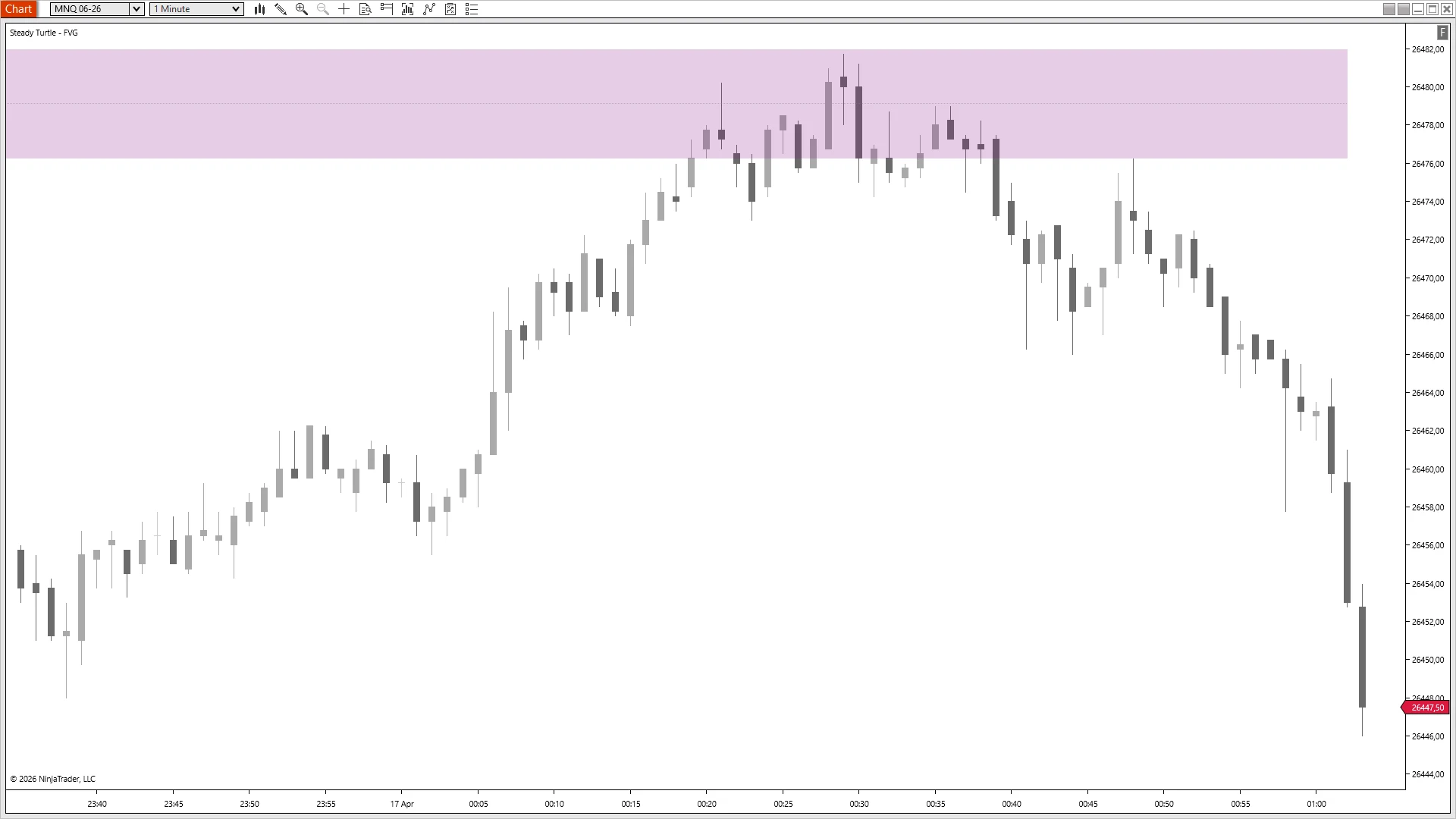
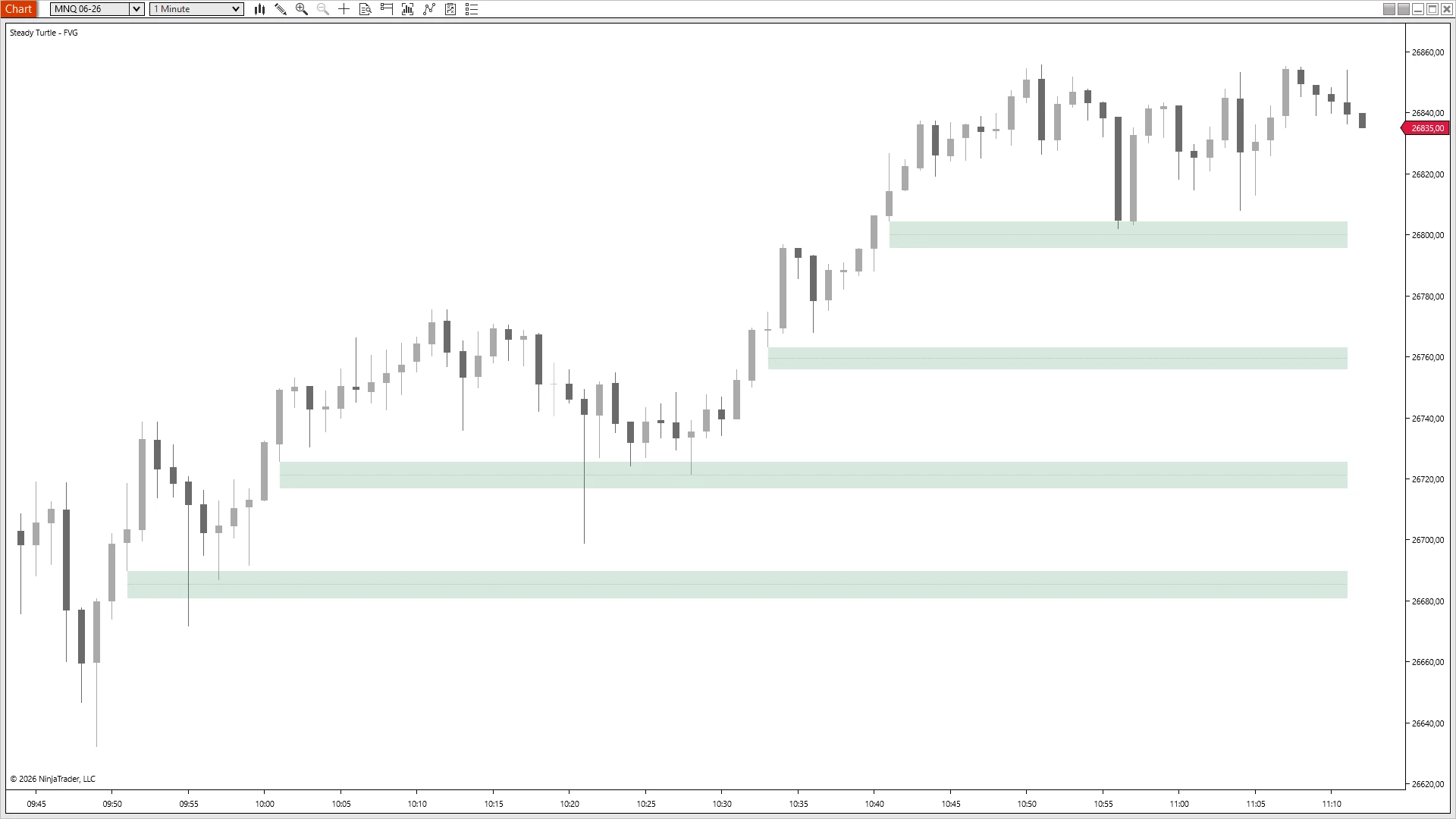
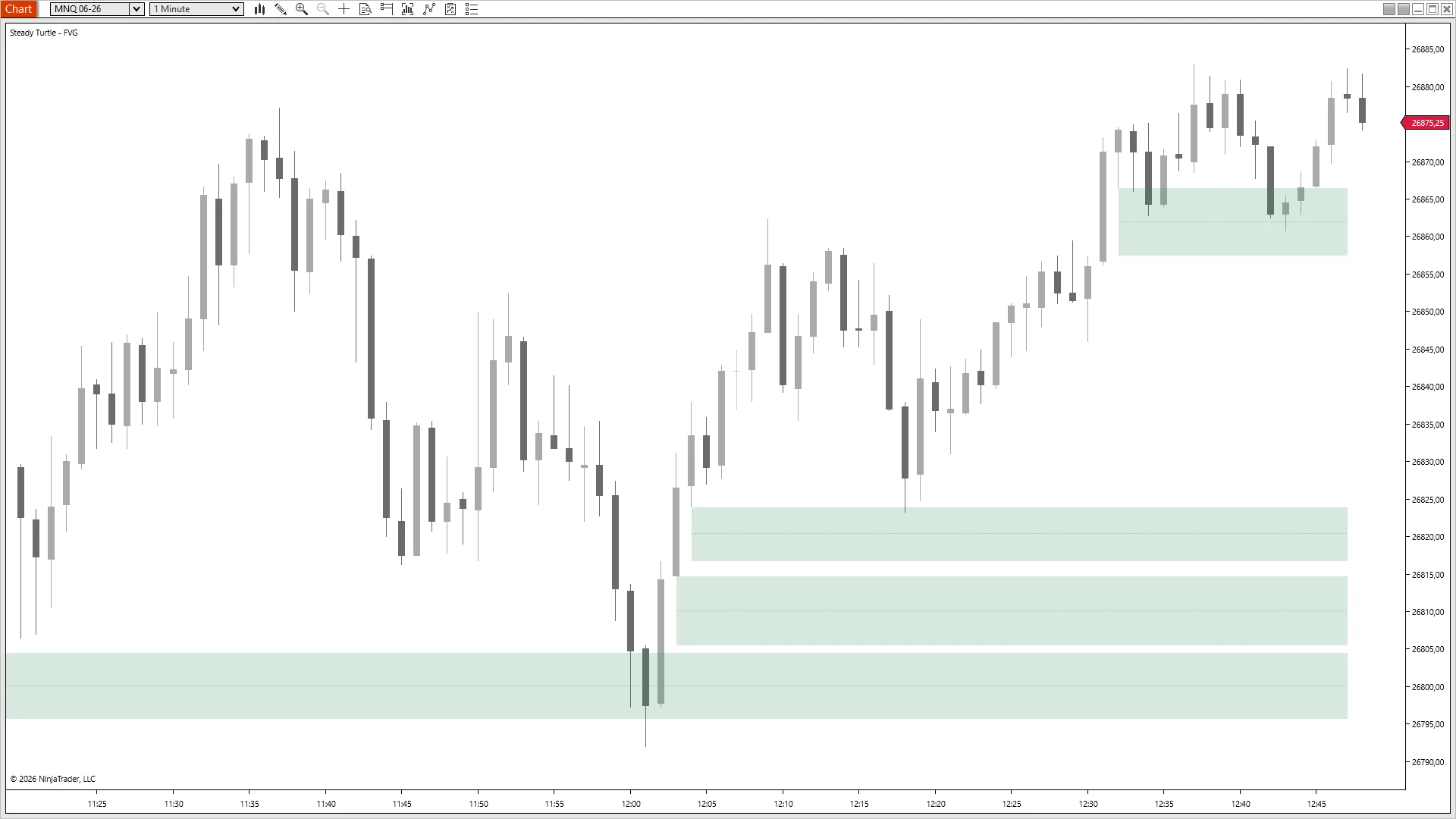
Free FVG Indicator in Action
See how the basic Fair Value Gap indicator marks price imbalances on ES and NQ futures charts.
Common Questions
- The free Basic FVG indicator detects standard bullish and bearish gaps—perfect for learning the fundamental concepts. The Professional IFVG indicator ($49) adds critical advanced features: inversion detection (when gaps change from support to resistance), dynamic color changes when smart money shifts bias, custom gap size filtering to eliminate noise, high-probability mode, and Strategy Builder integration.
- No. The free Basic FVG indicator requires no payment, no credit card, and no commitments. Just enter your email to receive the download link. We only ask for payment when you're ready to upgrade to the professional IFVG indicator.
- A Fair Value Gap (FVG) is a three-candle pattern where price moved so quickly that it left a gap between candle wicks. For a bullish FVG: the low of the third candle is higher than the high of the first candle. These gaps represent institutional buying or selling pressure and often act as support or resistance when price returns.
- Yes. Fair Value Gaps are a core concept in ICT (Inner Circle Trader) methodology. The free indicator helps you understand how institutions leave footprints in price action. Once you've validated the concept works for your trading, most traders upgrade to the pro version for advanced features like inversion tracking.
- Yes, the Basic FVG indicator works in real-time on live charts. However, day traders typically find they need the professional version's advanced features (inversions, size filtering, high-probability mode) for consistent results. The free version is best for learning and validating the concept.
- The indicator works on any instrument in NinjaTrader 8—futures, stocks, forex, or crypto. It's most commonly used on index futures (ES, NQ, YM, RTY) and oil futures (CL) where Fair Value Gap concepts are widely applied.
- When you're ready for advanced features, visit the Inverse FVG indicator page and purchase with one click. Both indicators can work together on your charts—the free version shows basic gaps while the pro version adds inversions and filtering.
- The free FVG indicator serves as your trial. It lets you validate that FVG trading works for your style before investing in the professional version. Once you've seen gaps hold as support/resistance, you'll understand why the inversion detection in the pro version is so valuable.
- Look for a three-candle pattern where price moved aggressively in one direction. For a bullish FVG: check if the low of candle 3 is higher than the high of candle 1 — the space between those two wicks is your gap. For a bearish FVG: check if the high of candle 3 is lower than the low of candle 1. The larger the gap, the more significant the imbalance. This indicator automates the detection so you never miss one, but understanding the visual pattern helps you confirm what you're seeing.
- It depends on your trading style. Day traders on ES and NQ typically use 1-5 minute charts for precise entries, but validate FVGs on 15-minute or 1-hour charts for higher-probability setups. Higher timeframe FVGs carry more institutional weight — a gap on the hourly chart is more significant than one on the 1-minute. Many traders use a top-down approach: identify FVGs on a higher timeframe, then drop down for entry timing. The indicator works on all timeframes in NinjaTrader.
- Yes — FVGs are particularly effective on liquid index futures like ES (S&P 500) and NQ (Nasdaq 100). These markets are dominated by institutional order flow, so the gaps represent real institutional imbalances rather than random noise from low liquidity. The high daily volume on ES and NQ means that when a Fair Value Gap forms, it took significant buying or selling pressure to create it. This makes ES and NQ some of the best instruments for FVG-based trading strategies.
- Both are ICT (Inner Circle Trader) concepts but they identify different things. A Fair Value Gap is a price imbalance — a gap between candle wicks where price moved too fast for proper order matching. An Order Block is the last opposing candle before a strong move, representing where institutions loaded their positions. They often work together: an Order Block candle frequently appears right before or at a Fair Value Gap. Think of Order Blocks as "where institutions entered" and FVGs as "where the market moved inefficiently because of that entry."
- Fair Value Gaps are a foundational concept in ICT (Inner Circle Trader) methodology and the broader Smart Money Concepts (SMC) framework. ICT teaches that institutional traders — banks, hedge funds, and large firms — create FVGs when they aggressively execute large orders. The theory is that price often returns to these imbalanced zones to allow remaining orders to fill, creating predictable trading opportunities. Whether you follow ICT specifically or SMC more broadly, understanding FVGs gives you insight into where institutional money has been active.
- FVGs represent inefficient price delivery — the market moved so fast that buy and sell orders weren't properly matched at every price level. Market makers and institutional algorithms tend to revisit these zones to "rebalance" unfilled orders. However, not every FVG gets filled completely. Strong trend FVGs may only see a partial fill (often to the 50% midline) before price continues. Range-bound or weak FVGs tend to fill entirely. Learning which gaps are likely to hold versus fill completely is a key skill — our 5-part FVG guide covers this in depth.
- This is one of the most powerful confluences in futures trading. When a Fair Value Gap aligns with the session VWAP or a high-volume node on the Volume Profile, you have two independent institutional references confirming the same level. For example, if a bullish FVG sits right at the VWAP, both price action and volume-weighted analysis agree that this is a significant support zone. Our free Volume Profile indicator and Session-Anchored VWAP pair perfectly with the FVG indicator for this approach.
- Less is more. Having too many FVGs on your chart creates analysis paralysis and makes it hard to identify which gaps actually matter. Focus on the most recent and largest gaps on your primary trading timeframe. As a rule of thumb, 3-5 active FVGs on a 5-minute chart is plenty for day trading ES or NQ. The professional IFVG indicator has built-in size filtering and a high-probability mode that automatically shows only the most significant gaps, eliminating the noise problem entirely.
Futures and forex trading contains substantial risk and is not for every investor. An investor could potentially lose all or more than the initial investment. Risk capital is money that can be lost without jeopardizing ones' financial security or life style. Only risk capital should be used for trading and only those with sufficient risk capital should consider trading. Past performance is not necessarily indicative of future results.
Testimonials appearing on this website may not be representative of other clients or customers and is not a guarantee of future performance or success.
Hypothetical performance results have many inherent limitations, some of which are described below. No representation is being made that any account will or is likely to achieve profits or losses similar to those shown; in fact, there are frequently sharp differences between hypothetical performance results and the actual results subsequently achieved by any particular trading program. One of the limitations of hypothetical performance results is that they are generally prepared with the benefit of hindsight. In addition, hypothetical trading does not involve financial risk, and no hypothetical trading record can completely account for the impact of financial risk of actual trading. For example, the ability to withstand losses or to adhere to a particular trading program in spite of trading losses are material points which can also adversely affect actual trading results. There are numerous other factors related to the markets in general or to the implementation of any specific trading program which cannot be fully accounted for in the preparation of hypothetical performance results and all which can adversely affect trading results.